Introduction
Artificial Intelligence development has changed dramatically in recent years. While cloud-based AI models like GPT-4 dominated the early AI boom, developers are now exploring local AI models that can run directly on their own machines.
Running AI locally provides several advantages:
- Complete privacy
- Faster response times
- No API costs
Moreover, modern GPUs and optimized inference engines have made it possible to run surprisingly powerful models even on consumer hardware. Interestingly, some of these local models are so advanced that developers claim they compete with or even outperform GPT-4 in certain coding tasks.
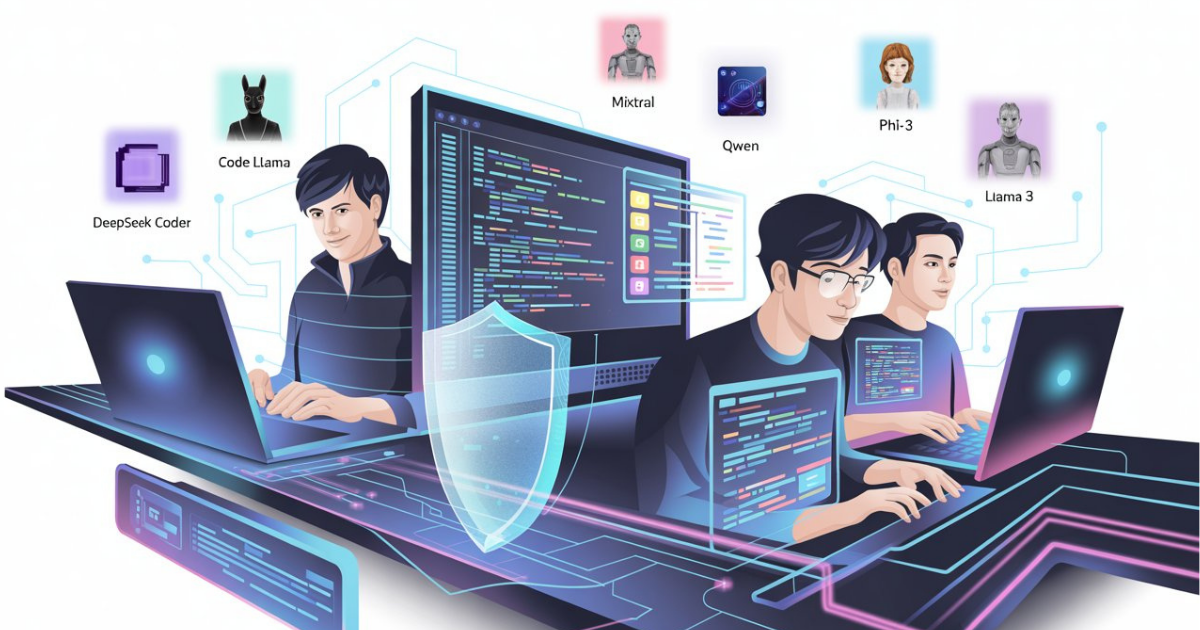
Below are seven extremely powerful local AI models developers are secretly using in 2026.
1. DeepSeek Coder
DeepSeek Coder has quickly become one of the most popular local models for programming tasks.
Why developers love it:
- Exceptional code generation ability
- Trained on billions of lines of code
- Works extremely well with IDE integrations
- Performs strongly in debugging tasks
Many developers claim that DeepSeek Coder produces cleaner and more structured code compared to many commercial AI models.
2. Code Llama
Code Llama is another strong model designed specifically for developers.
Key advantages:
- Excellent support for multiple programming languages
- Optimized for code completion and debugging
- Works smoothly with local inference tools like Ollama
Because of its flexibility, it is widely used in offline coding assistants.
3. Mistral Large / Mixtral
Mistral models are known for their high performance with relatively small size.
Why it stands out:
- Efficient mixture-of-experts architecture
- Fast inference speed
- Great reasoning abilities
Developers frequently use Mixtral locally because it provides high-quality responses while remaining efficient on modern GPUs.
4. Qwen Coding Models
Alibaba’s Qwen models have become increasingly powerful in the developer community.
Notable features:
- Strong multilingual coding support
- Good reasoning for complex problems
- Active open-source ecosystem
Many engineers consider Qwen models among the best open alternatives for coding tasks.
5. StarCoder2
StarCoder2 is another major player in the open AI coding ecosystem.
Why developers use it:
- Trained on a massive open code dataset
- Excellent code completion ability
- Optimized for collaborative development environments
It is particularly useful for automated documentation generation and refactoring tasks.
6. Phi-3 (Optimized for Local Machines)
Microsoft’s Phi models are designed to be small yet extremely capable.
Benefits:
- Runs smoothly on consumer GPUs
- Fast inference speeds
- Surprisingly strong reasoning ability
Because of its efficiency, Phi models are often used in lightweight local assistants.
7. Llama 3 Developer Variants
Meta’s Llama 3 ecosystem continues to dominate the open AI space.
Why developers rely on it:
- Massive community support
- Highly customizable
- Works well with tools like Ollama, LM Studio, and LocalAI
With fine-tuning, developers can turn Llama models into powerful coding copilots.
Why Developers Are Switching to Local AI
There are several reasons why developers are moving away from cloud-only models:
Privacy and Data Control
When running AI locally, your code never leaves your machine. This is extremely important for companies working on sensitive projects.
No API Costs
Using cloud AI APIs can become expensive over time. Local models remove this limitation entirely.
Faster Development Workflow
Local models provide instant responses without network latency, making development workflows much faster.
Hardware Requirements for Running Local AI
To run these models efficiently, developers typically use:
- GPUs with 8GB–24GB VRAM
- High-performance CPUs
- Fast NVMe SSD storage
- AI inference tools like Ollama or LM Studio
However, smaller models can still run on modern laptops with optimization techniques.
Final Thoughts
Local AI is quickly becoming a major trend in software development. With powerful models like DeepSeek Coder, Mixtral, and Code Llama, developers now have access to tools that can run entirely on their own machines.
As hardware continues to improve and open-source AI evolves, local models may soon become the default development assistant for programmers around the world.
For developers and studios like Riftwood Studio, exploring local AI tools could unlock faster workflows, better privacy, and lower operational costs.