
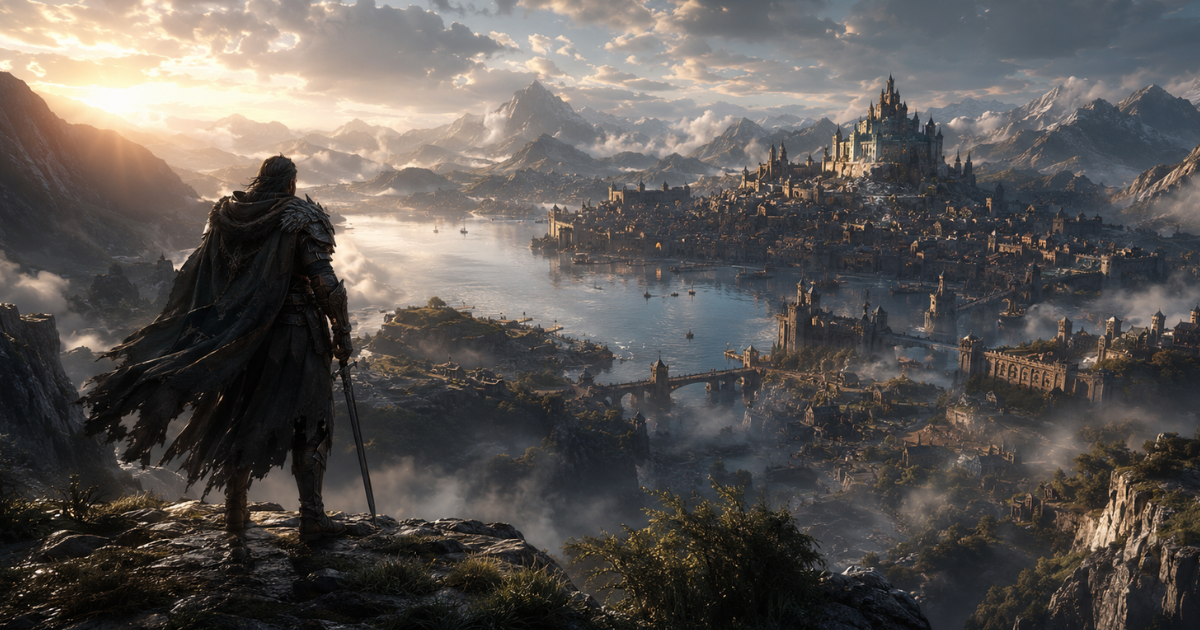
What Does "AAA Game" Actually Mean?
AAA games (pronounced "Triple-A") refer to titles developed and published with the largest budgets, biggest teams, and highest production values in the industry. The term isn't an official rating or certification — it's an industry shorthand, borrowed from the bond-rating world, used to signal "top-tier investment and top-tier expectations."
A AAA game typically means:
- Large development budgets — often tens or hundreds of millions of dollars.
- Big teams — hundreds of developers, artists, writers, and QA staff across multiple studios.
- High production values — cinematic cutscenes, full voice acting, detailed open worlds, and polished mechanics.
- Major marketing pushes — trailers, press events, and global release campaigns backed by large publishers.
- High commercial expectations — these titles are expected to sell millions of copies to justify the investment.
It's a budget and scale classification more than a quality guarantee — plenty of AAA games launch with rough edges, and plenty of smaller "indie" titles outshine them in design and storytelling.
AAA vs. AA vs. Indie Games
Understanding where AAA fits helps clarify the whole spectrum:
- AAA — massive budgets, large publisher backing, blockbuster scale (think major franchise entries from the biggest studios in gaming).
- AA (Double-A) — mid-sized budgets and teams, often more experimental or niche than AAA, without the same marketing scale.
- Indie — small teams, often self-funded or crowdfunded, prioritizing creative vision over commercial scale.
Some of the most critically loved games of the last decade have come from the AA and indie space precisely because they aren't chasing the same mass-market formula AAA studios often lean on.
A List of Notable Triple-A Games
While the "biggest" AAA titles shift with every console generation, certain games are consistently cited as defining examples of Triple-A production value, scale, and polish:
- Red Dead Redemption 2 — an open-world western built with an enormous attention to environmental and narrative detail.
- The Legend of Zelda: Breath of the Wild — a first-party flagship title showcasing massive open-world design on a first-party budget.
- God of War (2018) — a full franchise reinvention combining cinematic storytelling with high-fidelity combat systems.
- Grand Theft Auto V — one of the best-selling entertainment products of all time, spanning multiple console generations.
- Elden Ring — a genre-defining open-world title built on years of iterative, large-scale development.
- Cyberpunk 2077 — a high-profile example of both AAA ambition and the risks of overpromising before launch.
- The Witcher 3: Wild Hunt — a benchmark for narrative depth and side-quest design in open-world RPGs.
- Horizon Zero Dawn — a first-party title praised for its world-building and technical art direction.
- Marvel's Spider-Man — a licensed IP title that balanced blockbuster spectacle with tight, responsive gameplay.
- The Last of Us Part II — a heavily cinematic, story-driven title that pushed motion capture and facial animation further than most of its peers.
- Final Fantasy VII Remake — one of the earliest games widely credited with defining what "AAA budget" even meant in the industry.
- Halo (series) — a flagship franchise that helped establish the console-exclusive AAA shooter as a category of its own.
This list isn't exhaustive — it's meant to illustrate the range of genres, studios, and design philosophies that all fall under the "AAA" umbrella.
AAA Games by Platform
"AAA" isn't limited to one console or storefront — the classification applies across every major platform, though the scale can look different depending on where a game lives:
- PC AAA games — often benefit from the longest lifespan post-launch, with mod support, graphics settings scalability, and frequent post-release patches extending relevance for years.
- PlayStation AAA games — Sony has leaned heavily into first-party, story-driven exclusives as a core part of its AAA identity, often timed closely with new console launches.
- Xbox AAA games — Microsoft's AAA strategy has increasingly tied big releases to subscription access, changing how "day one" AAA releases reach players.
- Mobile AAA games — a newer and smaller category, but growing — high-budget mobile titles are starting to borrow console-level production values, though still rarely matching full AAA console budgets.
AAA Games by Genre
AAA budgets show up across nearly every genre, though certain categories have become closely associated with the classification:
- Open-world action-adventure — the genre most commonly associated with "AAA scale," due to how naturally large budgets translate into bigger, more detailed worlds.
- First-person shooters — long-running AAA franchises have defined multiplayer live-service models and annual release cycles.
- Sports and racing sims — yearly AAA sports titles rely on licensing deals, roster updates, and continuous online services to justify their release cadence.
- Role-playing games (RPGs) — some of the most narratively ambitious AAA titles come from this genre, where budget goes toward branching storylines, voice acting, and world-building.
- Fighting games — smaller in scope than open-world titles but still AAA in production polish, animation quality, and esports-driven marketing.
How AAA Games Are Marketed
Marketing budgets for AAA titles frequently rival — or exceed — a mid-budget indie game's entire development cost. A typical AAA marketing rollout includes:
- Multi-year hype cycles — teaser trailers and cryptic reveals starting years before release.
- Press and influencer previews — early hands-on access for major outlets and content creators ahead of launch.
- Global press events — dedicated reveal events, convention keynotes, and coordinated worldwide embargo drops.
- Collector's editions and pre-order incentives — exclusive in-game content or physical merchandise designed to drive early sales numbers.
- Cross-media tie-ins — licensing deals with movies, toys, or streaming adaptations that extend a franchise's reach beyond the game itself.
The Evolution of AAA Gaming
The term "AAA" started gaining traction in the late 1990s and early 2000s, as development budgets began climbing into the tens of millions of dollars. Titles that once cost a few hundred thousand dollars to make began requiring dedicated teams, licensed engines, and orchestral scores. Over the following two decades, AAA budgets kept climbing — today, some of the biggest titles reportedly cost hundreds of millions of dollars once marketing is factored in.
That growth has changed player expectations permanently. Features that were once considered premium — voice acting, open worlds, seasonal content — are now baseline expectations for anything marketed as AAA.
Why AAA Development Is So Resource-Intensive
The scale of a AAA game creates its own set of challenges:
- Longer development cycles — many AAA titles take four to six years (or longer) from pre-production to release.
- Higher financial risk — a single underperforming AAA release can cost a studio hundreds of millions of dollars.
- Crunch culture concerns — the pressure to hit release windows with such large scopes has fueled ongoing industry conversations about sustainable development practices.
- Live-service pressure — many modern AAA titles are expected to keep expanding post-launch with updates, seasons, and monetization systems, turning a "finished" game into an ongoing product.
Is AAA Still the Gold Standard?
The gaming landscape has shifted. Mid-budget "AA" titles and polished indie games increasingly compete with — and sometimes outshine — AAA releases in terms of critical reception and player loyalty. Smaller teams can iterate faster, take creative risks big publishers won't greenlight, and build tightly-scoped experiences without the bloat that sometimes comes with massive scope.
That doesn't make AAA irrelevant — it still delivers experiences that smaller budgets simply can't replicate in terms of scale and spectacle. But "AAA" is no longer synonymous with "best." It's one production model among several, each with its own strengths.
Building at Any Scale
Not every great game needs a hundred-million-dollar budget. Plenty of successful, polished titles are built by small, focused teams with the right technical foundation — solid systems architecture, clean gameplay mechanics, and smart scope management from day one.
This is where Riftwood Studio comes in. Riftwood Studio is a full-service creative technology studio building custom Unity and mobile games — from core gameplay systems and AI-driven mechanics to monetization, ads integration, and live-ops features that mirror what larger studios build, without requiring a AAA-sized budget. Whether you're prototyping a mobile game or building a full-scope title, Riftwood Studio can architect it properly from the ground up.
If you're also managing game marketing assets — screenshots, trailers, or store page graphics — OmnifyTools' free Image Compressor is a quick way to keep those files lightweight without losing visual quality.
FAQ
What does "AAA" stand for in gaming?
It doesn't stand for specific words — it's a tier classification borrowed from bond-rating terminology, signaling top-tier budget and production scale.
Is a AAA game always better than an indie game?
No. AAA refers to budget and scale, not guaranteed quality — many critically acclaimed games come from smaller AA or indie studios.
What's the difference between AAA and AA games?
AAA titles have significantly larger budgets, teams, and marketing campaigns than AA games, which typically operate with mid-sized budgets and more creative flexibility.
Why do some AAA games launch with bugs despite huge budgets?
Large scope, tight release windows, and live-service pressure can outpace QA timelines, even with substantial resources behind development.
How much does it cost to make a AAA game?
Modern AAA budgets commonly range from tens of millions of dollars into the hundreds of millions once marketing spend is included.
How long does it take to develop a AAA game?
Most AAA titles take somewhere between four and six years from initial pre-production through final release, though some run longer.
What is the difference between a AAA game and a live-service game?
AAA describes budget and production scale; live-service describes a monetization and content-delivery model. A game can be both — a big-budget AAA title built around ongoing seasons and updates — or just one of the two.
Are AAA games always single-player or always multiplayer?
Neither — AAA budgets fund single-player narrative epics, competitive multiplayer shooters, and hybrid experiences alike. The classification is about scale, not gameplay format.
What comes after AAA — is there a "AAAA" tier?
Informally, some in the industry have floated the idea of a "AAAA" tier for the very largest, most expensive productions, but it isn't a standardized or widely adopted classification.
Have a game idea that doesn't need a AAA budget to feel polished and complete? Riftwood Studio builds custom Unity and mobile games from concept to launch. And for optimizing your marketing assets along the way, the free Image Compressor on OmnifyTools keeps things fast and lightweight.